
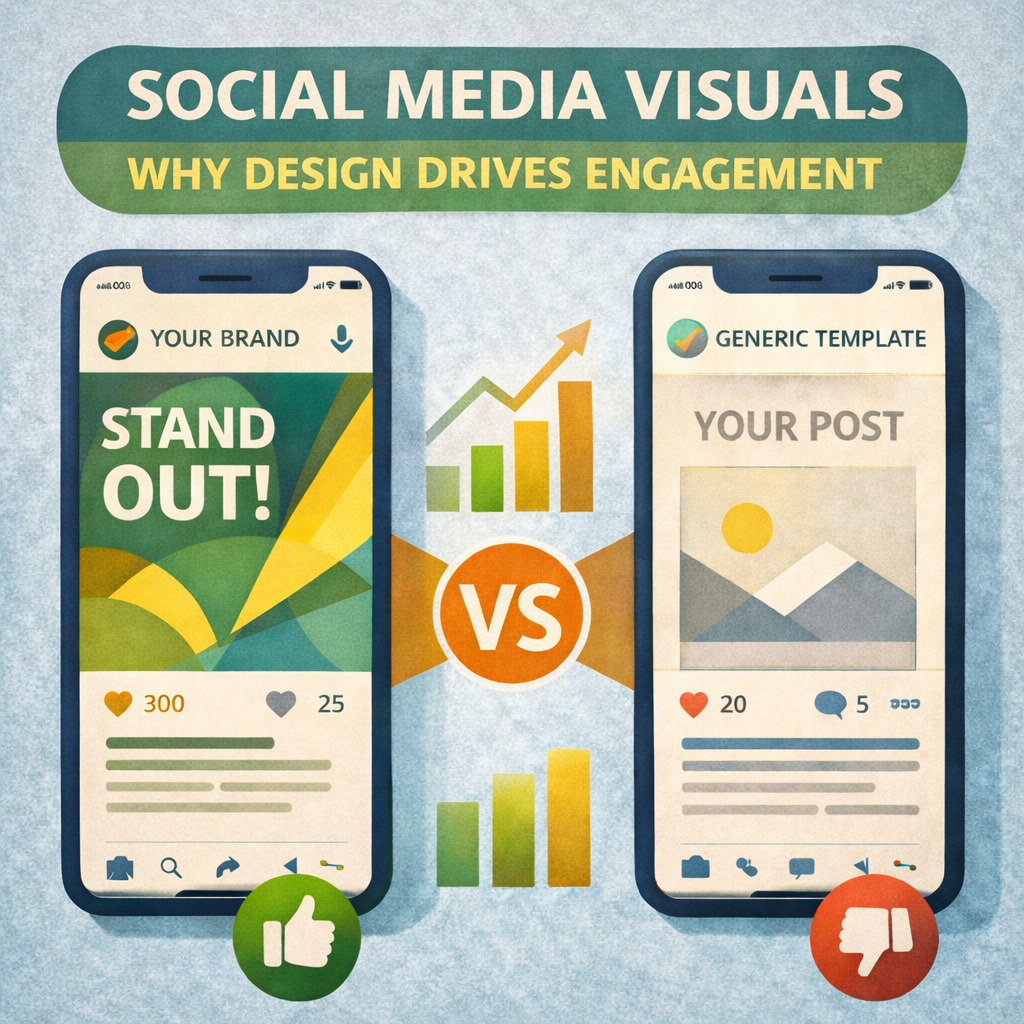
Social media design has become one of the most influential factors in digital marketing success. In a world where users scroll rapidly through endless streams of content, visual impact determines whether a brand captures attention — or gets ignored.
While algorithms, captions, and hashtags all play important roles, design is often the deciding factor in engagement performance. Strong visuals stop the scroll. Weak visuals disappear into the noise.
Social media design is no longer aesthetic polish.
It is an engagement strategy.
Table of Contents
Why Social Media Design Matters
Users process visuals faster than text. Before reading captions or evaluating messaging, audiences react to imagery, typography, colours, and layout composition. This immediate visual judgment shapes engagement behaviour.
Professional social media design builds credibility and trust instantly. Poor design often signals amateurism or low perceived value. In competitive feeds, perception drives interaction.
Visual quality influences whether users pause, engage, or continue scrolling.
Visual Content Competes for Attention
Social platforms are saturated environments. Every post competes with ads, videos, influencers, and brand content. Attention is scarce.
Effective social media design uses contrast, hierarchy, and clarity to interrupt scrolling patterns. Bold typography, strong focal points, and clean compositions increase visibility.
Design controls attention capture.
Attention capture controls engagement.
Design Directly Impacts Engagement Metrics
Engagement is heavily influenced by visual presentation. Posts with professional social media design consistently outperform generic or template-heavy visuals.
Well-designed posts improve:
✔ Likes and reactions
✔ Shares and saves
✔ Click-through rates
✔ Brand recall
✔ Audience trust
Design is not subjective decoration.
It is measurable performance.
Consistency Strengthens Brand Recognition
Brand recognition relies on repetition and cohesion. Social media design should align with overall brand identity — colours, typography, imagery style, and tone.
Consistent visuals help audiences recognize posts instantly without relying on logos. This familiarity strengthens recall and improves long-term engagement.
Consistency transforms design into brand memory infrastructure.
Poor Social Media Design Creates Hidden Costs
Low-quality visuals rarely trigger immediate alarm, but their impact accumulates quietly. Poor social media design often leads to reduced engagement, weaker credibility, and ineffective campaigns.
Common problems include:
• Cluttered layouts
• Weak hierarchy
• Inconsistent branding
• Poor readability
• Generic template overuse
Ineffective visuals reduce marketing ROI.
Professional Social Media Design Drives Results
Professional design blends strategy, psychology, and visual hierarchy. It guides attention, communicates credibility, and enhances clarity.
Strong social media design helps brands:
✔ Stand out in crowded feeds
✔ Build trust instantly
✔ Increase engagement
✔ Strengthen brand recognition
✔ Improve conversions
Design influences perception.
Perception influences behaviour.
Behaviour drives results.
Final Thoughts: Design Drives Engagement
Social media is a visual-first environment. Users respond to what they see before what they read.
Investing in professional social media design means investing in visibility, credibility, and engagement performance. Strong visuals create stronger reactions, deeper interaction, and better marketing outcomes.
Good design doesn’t just make posts look better.
It makes posts perform better.